
What a Record Year of Immigration Restraint Means for You

This has been a week of blunt talk in Canadian immigration. From a Prime Minister openly defending “a few more years of restraint” to a $100-million cut to federal business immigration, the message from Ottawa this week is consistent: the system is being tightened deliberately, not accidentally. For applicants and employers, that means the path forward runs increasingly through the provinces — and increasingly requires patience. Here's everything that moved this week.
Express Entry: A Slower, Steadier July Comes to a Close
IRCC closed out July 2026 having run eight Express Entry draws across five categories, issuing 15,549 invitations to apply (ITAs) for the month. That brings the 2026 year-to-date total to 104,616 invitations across 42 draws — already ahead of the 98,903 ITAs issued in all of 2024, even as the pace of individual draws continues to slow.
This week's key rounds
● July 22 — French-language proficiency category draw: 5,000 ITAs at a CRS cutoff of just 399, the most accessible cutoff of the year and a reminder that French ability remains the single fastest route into the pool for candidates below CRS 500.
● July 23 — Skilled Military Recruits category draw: the first-ever round for this brand-new 2026 category, issuing just 4 ITAs at a CRS cutoff of 368.
● Canadian Experience Class cutoffs held steady in the 507–518 range all month, with no sign of dropping below 500 before Q4.
● Provincial Nominee Program draws continue to command the highest cutoffs of any category, reflecting the 600-point CRS boost every nomination carries — and the outsized role provinces are now playing in federal selection.
Looking at the shape of the year so far, French-language candidates have received roughly 40,500 of the 104,616 ITAs issued in 2026 — by far the largest single channel. If your CRS score sits in the 400–507 range, a category draw, a provincial nomination, or French test results remain your three realistic doors into an invitation this year.
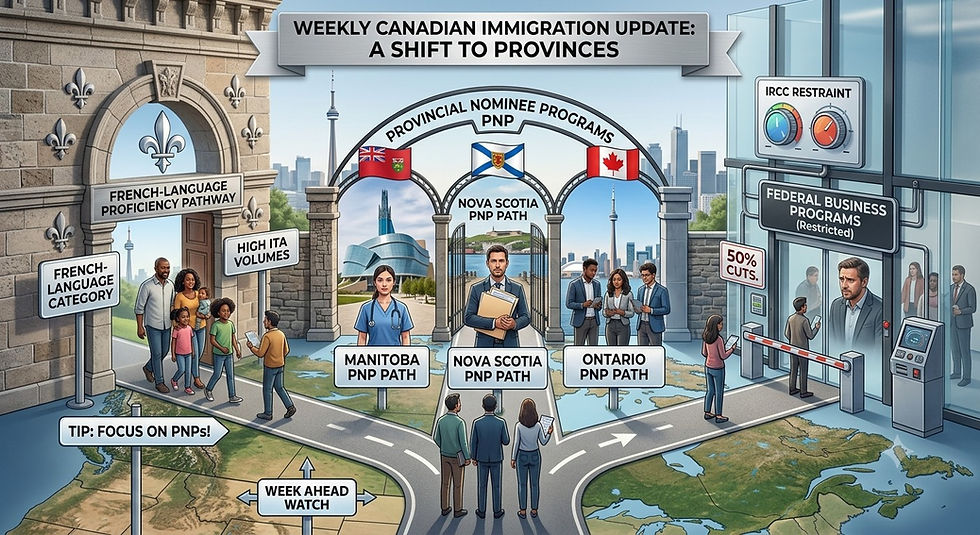
Provincial Nominee Programs: Manitoba and Nova Scotia Move, Ontario Waits
Manitoba — a busy month closes with a draw
Manitoba capped a very active July with its third Expression of Interest draw of the month. Draw #276 (July 30) issued 766 Letters of Advice to Apply across its Skilled Worker selections. That followed Draw #275 (July 16), Manitoba's largest single round of the year at nearly 2,000 LAAs spanning the International Education Graduate Internship Pathway, priority medical occupations, and top-scoring profiles, and the smaller, employer-driven Draw #274 (July 2) with 77 LAAs. Manitoba's message this month has been consistent: strategic recruitment, healthcare retention, and top-scoring profiles are all getting real invitation volume, even as the province manages a growing EOI pool.
Nova Scotia — a one-time lifeline for workers with expiring permits
Nova Scotia announced a one-time expansion of its selection priorities under the Nova Scotia Nominee Program and the Atlantic Immigration Program, aimed squarely at candidates already living and working in the province whose work permits expire in 2026 or earlier. This is not a new intake — only candidates who already had an eligible Expression of Interest on file by June 30, 2026 can be considered — but it broadens who the province may select from that existing pool, including TEER 0–4 workers in priority sectors, Nova Scotia graduates in TEER 0–5 roles, candidates outside the Halifax Regional Municipality, and workers earning at least $27/hour. Selected candidates will be contacted directly; meeting the criteria does not guarantee an invitation.
Ontario — still waiting on the Workforce Priority portal
Ontario's new Workforce Priority (OWP) Stream, which replaced all eight former OINP streams on June 26, 2026, published its detailed EOI scoring framework in late July — but the EOI portal itself remains closed. Ontario continues to say it expects to reopen registrations “later this summer,” with no confirmed date yet. Candidates with pending EOIs under the old streams should note these are being automatically withdrawn if they never received an invitation; the safest move right now is to prepare your documents and watch for the reopening rather than assume anything carries over.
Business Immigration & Start-Up Visa: A Program Under Real Pressure
The federal government's 2026–2028 Immigration Levels Plan is now showing its teeth. Federal Business Programs admissions — which include the Start-Up Visa — are being cut by fully 50%, down to just 500 admissions for 2026. Vancouver immigration lawyer Steven Meurrens, whose commentary we track closely for our C-11 and business-stream clients, has also flagged an internal IRCC email confirming that the department's Permanent Economic Immigration Unit is actively developing measures to reduce the Start-Up Visa Program's application inventory.
For clients considering the Start-Up Visa or C-11 significant-benefit work permit routes, the takeaway is the same one we've been giving all year: with federal business-stream capacity shrinking sharply, provincial entrepreneur and nominee pathways — like the ones several of our clients have already used successfully in Nova Scotia and Saskatchewan — are becoming the more realistic vehicle for business immigration to Canada in the near term.
From Ottawa: Carney Defends “A Few More Years of Restraint”
Prime Minister Mark Carney used a July 29 press conference in Red Deer, Alberta to deliver his most direct comments yet on immigration policy, framing the last year of cuts as a deliberate correction rather than a temporary adjustment.
Immigration was far too high when his government took over, and Canada had lost control of its intake of foreign students and temporary workers — though overall levels are still putting pressure on housing, so the country still needs a few more years of restraint. — Prime Minister Mark Carney, Red Deer, Alberta, July 29, 2026
Carney pointed to the numbers behind that claim: asylum claims are down roughly a third, temporary foreign worker arrivals are down by half, and international student arrivals are down by two-thirds compared to recent peaks. Only about 19,000 study permit holders and 78,000 temporary workers arrived between January and May 2026, a sharp drop from the more than 115,000 students and nearly 209,000 workers who arrived across all of 2025.
The remarks came amid discussion of Alberta's upcoming referendum on provincial control over immigration. Premier Danielle Smith argued Alberta needs more autonomy over its own Provincial Nominee Program allocation — currently about 6,400 spots against roughly 40,000 candidates seeking permanent residence through the province — pointing to Quebec's much larger, independently negotiated intake of about 45,000 as a model. Carney confirmed he and the premiers had discussed prioritizing specific in-demand skills for economic immigrants at their recent Prince Edward Island meeting, suggesting provincial bargaining power over selection criteria is likely to keep growing.
Minister Lena Diab, meanwhile, kept a steady public schedule this week, appearing in Vancouver on July 28 alongside Parliamentary Secretary Annie Koutrakis to announce upcoming online passport renewal services — a smaller but telling signal that IRCC's modernization push continues even as intake levels are being held down.
Week Ahead: What to Watch
● Express Entry — IRCC is expected to open at least two draw clusters in August, with the first round of invitations projected for the week of August 3.
● Ontario OWP — keep watching for a confirmed EOI portal reopening date; “later this summer” could land any time in August.
● Alberta — continued fallout from the province's referendum debate on immigration control is likely to keep PNP allocation in the national conversation.
● Business immigration — watch for further IRCC guidance on Start-Up Visa inventory management following this week's reporting.
Immigration Tip of the Week
With Federal Business Programs cut in half and Express Entry cutoffs staying stubbornly high outside category draws, this is the year to stop treating a provincial nomination as a “backup plan.” A single nomination adds 600 CRS points — more than enough to leapfrog almost any general draw cutoff we've seen in 2026. If your profile is strong in a specific occupation or region, actively target the PNP streams that match it (Manitoba's Skilled Worker stream and Nova Scotia's priority occupations are both moving right now) rather than waiting on a federal draw that may never reach your score.
This blog is for informational purposes only and does not constitute legal advice. Immigration policies and procedures can change; please contact Elgin Immigration for advice specific to your situation.

Comments