
Ontario Reopens the Door: What This Week's Immigration Shifts Mean for You

This has been one of the more consequential weeks for Canadian immigration in months. Ontario has finally reopened its flagship provincial pathway after a ten-week gap, Express Entry has settled into a steady late-summer rhythm, and both Prime Minister Mark Carney and Minister Lena Diab made public remarks that shed light on where federal immigration policy is heading. Here is what happened, and what it means for you.
Express Entry: This Week's Draws
IRCC opened August with its usual two-draw cluster and has now issued over 111,000 invitations to apply (ITAs) so far in 2026, comfortably ahead of the 98,903 invitations issued across all of 2024.
● August 4 (PNP-specific): 507 ITAs at a CRS cutoff of 768 — 24 points higher than the July 20 PNP round, reflecting a thinner nomination pipeline feeding the pool.
● August 5 (Canadian Experience Class): 3,000 ITAs at a CRS cutoff of 516, a 50% jump in volume from the previous two CEC rounds without any movement in the cutoff — a sign the pool is replenishing with high-scoring CEC candidates as fast as IRCC can invite them.
● August 6 (French-language proficiency): 5,000 ITAs at a CRS cutoff of just 391, underscoring how francophone category draws remain the highest-volume category-based pathway of 2026.

PNP Update: Ontario's Workforce Priority Stream Opens for Business
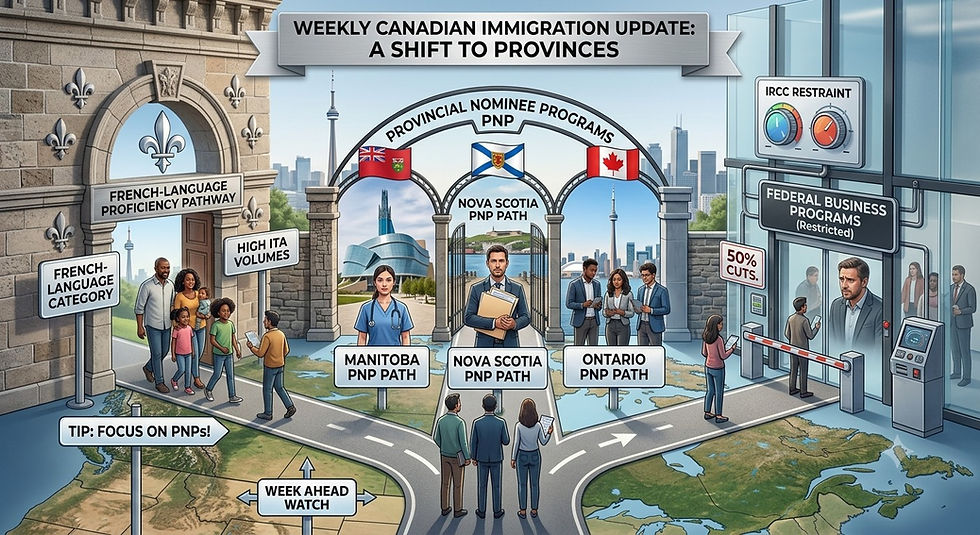
The headline development this week is out of Queen's Park. On August 4, 2026, the Ontario Immigrant Nominee Program opened its Expression of Interest portal for the new Ontario Workforce Priority (OWP) Stream — the pathway that replaced all eight of Ontario's former OINP streams when they sunset on May 30, 2026.
The OWP Stream runs on three tracks:
● A higher-skilled worker stream (TEER 0–3 occupations) tied to a qualifying job offer from a registered Ontario employer.
● A lower-skilled worker stream (TEER 4–5 occupations), also job-offer-based.
● A self-employed physicians stream for doctors registered to practise in Ontario and eligible to bill OHIP.
Employers must first register in the OINP's Employer Portal and post a qualifying job offer before a candidate's EOI can be linked and considered. Once invited, candidates have just 17 calendar days to submit a complete application — a tight window that makes advance document preparation essential. High-skilled and physician-stream nominees may also qualify for the Enhanced Provincial Nominee Program's faster federal processing through Express Entry.
For clients who had an EOI sitting in limbo since the June 25 portal closure: those profiles were automatically withdrawn by the province. Everyone needs to re-file under the new OWP criteria. Ontario has also signalled that a second phase — priority healthcare worker, entrepreneur, and exceptional talent streams — is still to come, with no confirmed launch dates yet.
Elsewhere, BC PNP's Temporary Rural/Remote Health Support Initiative remains open for registrations until August 31, 2026, offering up to 250 nominations for healthcare workers willing to commit to underserved communities.
Business Immigration: Start-Up Visa Stays Closed, Pilot Still Pending
Entrepreneur clients should know the Start-Up Visa program remains fully closed to new applicants. IRCC stopped accepting new SUV applications on June 30, 2026, after processing times had stretched past ten years for some files. The department's 2026-27 Departmental Plan confirms a replacement is coming — a "high-impact" Start-Up Visa pilot aimed at experienced founders with funded, high-traction ventures rather than early-stage ideas — but no launch date has been announced.
The federal Business Programs allocation was also cut by half under the current Levels Plan, from 1,000 to 500 admissions annually, so competition for whatever pilot emerges will be steep. In the meantime, entrepreneur clients still have real options: certain PNP entrepreneur and business streams, the C-11 significant-benefit work permit, and TR-to-PR pathways for founders already working in Canada. We continue to recommend using this pause productively — refine the business plan, strengthen Canadian market validation, and shore up language scores so the file is ready the moment a new door opens.
From Ottawa: What Carney and Diab Are Saying
Speaking in Red Deer, Alberta on July 29, Prime Minister Carney said his government has "taken back control" of immigration, pointing to a one-third drop in asylum claimants, a 50% drop in temporary foreign worker arrivals, and a two-thirds drop in international student arrivals compared to peak levels. He acknowledged that immigration volumes are still contributing to housing pressure and suggested there is a case for "a few more years" of restrained intake, while noting that he and the provincial premiers recently discussed prioritizing specific in-demand skills for economic immigrants at their meeting in Prince Edward Island.
The remarks came against the backdrop of Alberta's upcoming referendum asking residents whether the province should assume greater control over immigration selection, including a proposal to restrict provincially funded services to citizens, permanent residents, and holders of "Alberta-approved" status — a debate worth watching for anyone with clients tied to that province.
Minister Diab, for her part, joined Parliamentary Secretary Annie Koutrakis in Vancouver in late July to announce improvements to online passport renewals, and has continued to face questions in the House on processing delays and program design. Taken together, the messaging from both the PM's office and IRCC this summer points the same direction: tighter temporary resident intake, continued emphasis on economic and provincially-nominated candidates, and caution before any expansion of federal admissions targets.
Week Ahead Outlook
Based on the current draw cadence, expect a second Express Entry cluster before the end of August, likely another PNP-specific round in the 400–600 ITA range with a CRS cutoff somewhere between 720 and 760, alongside a possible healthcare or category-based round. On the provincial side, all eyes are on how quickly Ontario begins issuing invitations under the new OWP Stream now that the EOI portal is live — early movers with strong employer offers are likely to see the fastest results. We will also be watching for any additional detail on the promised high-impact Start-Up Visa pilot as IRCC works through its departmental planning cycle.
Immigration Tip of the Week
If you have an Ontario employer job offer in hand, do not wait to register: employers must be registered with the OINP Director in the Employer Portal before any candidate EOI can be linked to that offer. Given the 17-day response window once an invitation is issued, the fastest way to protect your place in line is to have your employer registration, job offer documentation, and settlement funds evidence ready before you submit your Expression of Interest — not after.
This blog is for informational purposes only and does not constitute legal advice. Immigration policies and procedures can change; please contact Elgin Immigration for advice specific to your situation.
Comments